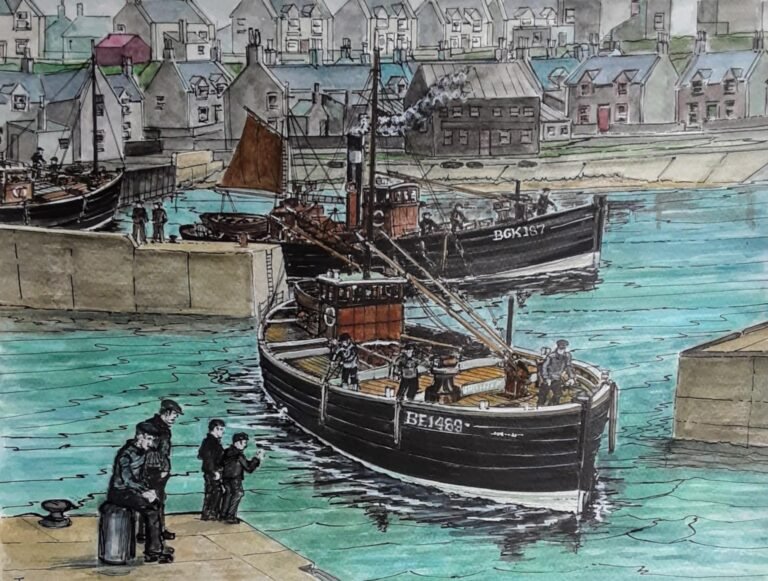
The History of Findochty
A historic fishing village on the Moray Firth coast
- Origins: Medieval estate centred on Findochty Castle (15th–16th century)
- Expansion: Harbour development and organised fishing in the 1700s
- Peak Industry: Herring boom of the 18th and 19th centuries
- Change: Commercial decline in the late 19th and 20th centuries
- oday: A residential coastal village shaped by its maritime heritage
Findochty grew from farmland surrounding Findochty Castle into one of the Moray Firth’s important fishing communities. Shaped by its natural harbour and sheltered waters, the village developed a strong maritime identity that still defines its character today.
Origins of the Village
The earliest recorded references to the lands of Findochty date to the 15th century, when they were granted to the Ogilvie family. The castle formed the centre of the estate and provided protection along this stretch of coastline.
For many years the area consisted mainly of farmland with a small coastal settlement. Its position beside sheltered waters made it suitable for boats, and fishing activity gradually increased.
By the 1700s, a small harbour settlement had taken shape. In 1716, fishermen were brought from Fraserburgh to establish organised fishing, laying the foundations for Findochty’s development as a recognised fishing community.
Findochty Today
During the 20th century, the village became increasingly residential while retaining its traditional character. The harbour now serves small fishing boats and leisure craft, and the narrow streets, shoreline cottages and harbour walls remain strong reminders of its working past.
Findochty’s maritime heritage continues to shape village life, from coastal walks and community events to the preservation of its historic landmarks.
Community Life
Findochty has long been shaped by strong community ties. Families often lived and worked locally for generations, creating a shared identity closely connected to the sea.
Today, the village continues to host local events and maintain traditions linked to its fishing heritage, balancing its history with a vibrant present.
The Fishing Port Years
Growth of the Harbour
Through the 18th century the harbour expanded to support a growing fleet. The village developed around the shoreline, with houses built close to the sea so fishermen could reach their boats quickly. The tight streets and compact layout seen today reflect that working harbour past.
The Herring Boom
During the 18th and 19th centuries, Findochty thrived on herring and white fish. At its peak, the harbour supported around 140 boats and a large workforce.
Fishing shaped every part of community life. While men worked at sea, women prepared, salted and packed fish for transport to markets across Scotland and beyond. The industry supported not only fishermen, but coopers, net makers and merchants, creating a busy and interdependent coastal economy.
Decline and Change
By the late 19th century, larger and deeper harbours, particularly nearby Buckie, began to attract bigger vessels and commercial traffic. As fishing methods changed and fleets consolidated, activity in Findochty gradually reduced.
The harbour adapted to smaller boats and later leisure craft. Although large-scale commercial fishing declined, local fishing never fully disappeared and continues on a smaller scale today.
Visiting Findochty
Visitors can explore several features connected to the village’s history
- Harbour and shoreline walks
- The Moray Coastal Trail
- Coastal viewpoints and beaches
- Historic buildings and memorials
- Local facilities within walking distance
Historic Landmarks
Findochty Castle
Originally the centre of the estate, Findochty Castle dates from the 16th century and reflects the village’s early development. Once a fortified tower house of the Ogilvies, it stands as a reminder of Findochty’s medieval roots and changing fortunes over the centuries.
The Harbour and Piers
Shaped by the sea, Findochty Harbour has long been the heart of the village. Developed and expanded during the great fishing era of the 19th century, its piers and sheltered basin reflect the community’s deep connection to the herring industry and maritime life.
War Memorial
Perched above the harbour, this memorial honours the men and women of Findochty who gave their lives in the First and Second World Wars.
The “Mannie” Statue
Since 1959, the White Mannie has stood proudly overlooking Findochty Harbour — a symbol of our fishing roots and community pride, watching the waves just as generations have watched over the village.