
The atmosphere, the greenhouse effect, and the systems that move heat around the planet.
Weather vs. climate
Weather is what's happening outside right now: rain today, sunshine tomorrow. Climate is the average pattern of weather over a long period, usually 30 years or more.
Scotland's climate has always varied year to year. What's changed is the long-term average — and that's what this resource sets out.
Why the UK's climate is relatively mild
Britain sits at a latitude that would normally be much colder, similar to parts of Canada or Russia. It stays milder because of the constant exchange of heat around the planet, largely driven by the Gulf Stream.
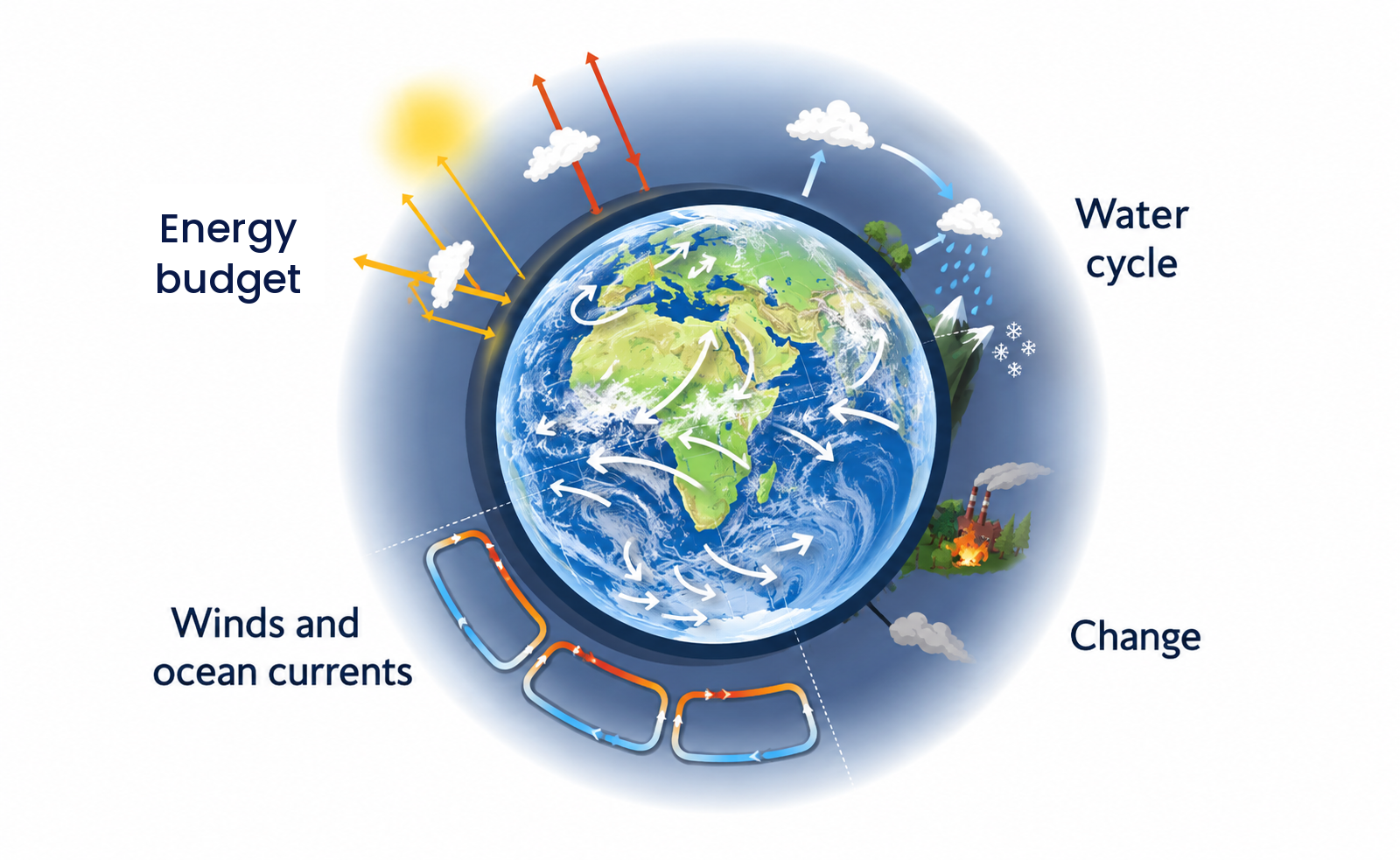
That balance is delicate. Shift it even slightly, and weather patterns change.
The greenhouse effect
The Earth is kept warm by a natural process called the greenhouse effect. Certain gases in the atmosphere — mainly carbon dioxide (CO₂), methane (CH₄), and nitrous oxide (N₂O) — trap some of the sun's heat rather than letting it escape back into space.
💡 Without this effect, Earth would be around 30°C colder, far too cold to support life as we know it.
The problem isn't the greenhouse effect itself. Human activity has been adding much more of these gases to the atmosphere than natural processes remove, mainly by burning fossil fuels for energy, transport and industry, and through farming and land use.
More greenhouse gas means more heat trapped and a warmer planet overall.
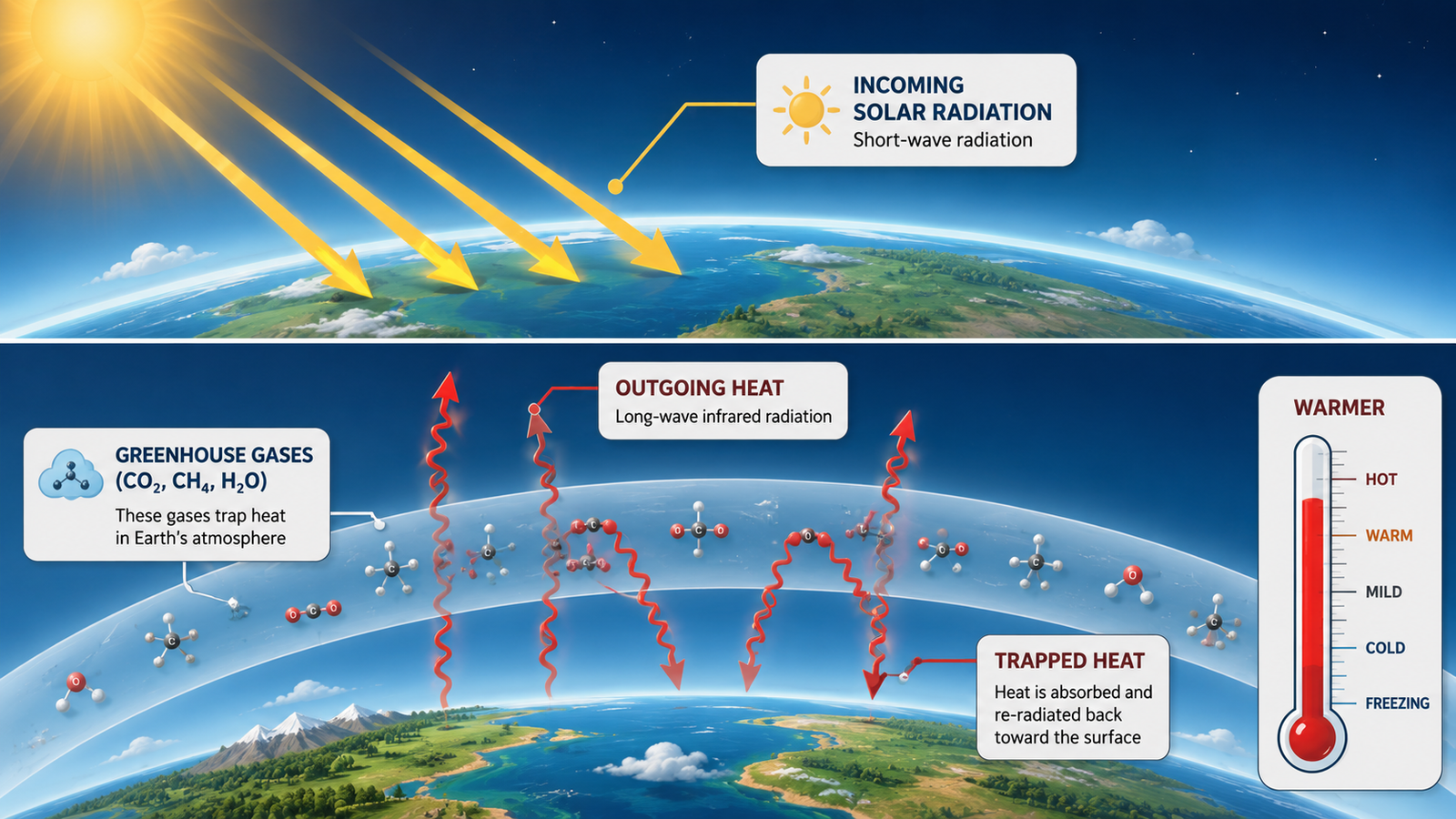
☀️ Incoming sunlight warms the Earth's surface. Greenhouse gases trap part of the heat trying to radiate back into space.
Three fundamentals worth knowing
Climate change connects to three underlying systems. Two are natural cycles, while the third is a balance that's been thrown off.
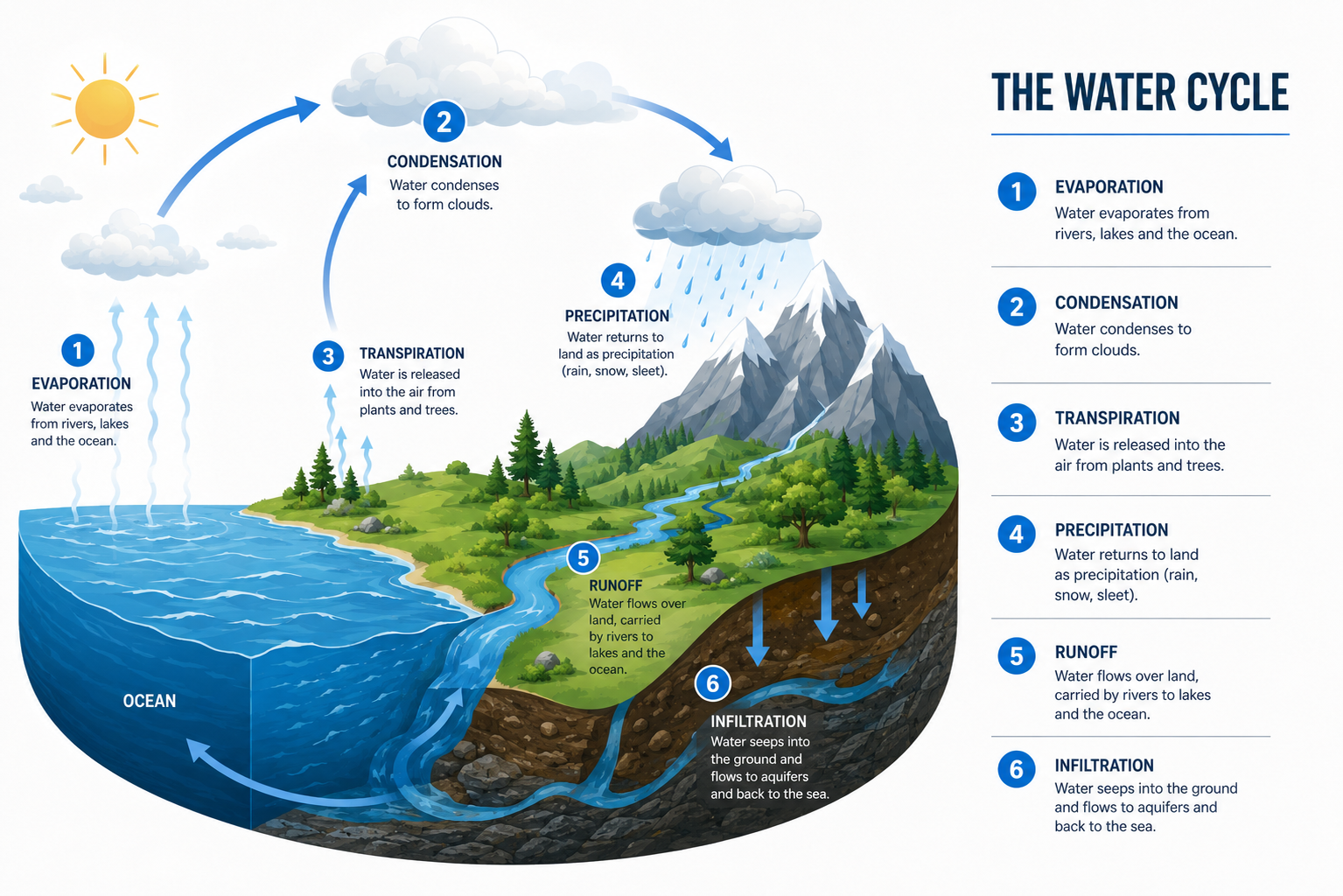
💧 The water cycle
Evaporation, cloud formation, and rainfall. A warmer atmosphere can hold more moisture — roughly 7% more for every 1°C of warming — so when it does rain, it can rain harder.
⚡ Earth's energy budget
Not a cycle in the same sense as the other two, it's the balance between energy arriving from the sun and energy leaving the Earth as heat. In a stable climate, these flows balance out. Since at least the 1970s, they haven't: more energy has been arriving than leaving, mainly because greenhouse gases trap outgoing heat (the effect covered above), partly offset by pollutant aerosols reflecting some incoming sunlight away.
Where does that trapped energy actually go? Mostly into the ocean, about 91% of it, based on measurements since 1970, with land absorbing around 5%, melting ice around 3%, and the atmosphere itself only around 1%, despite being where most of the measured warming is felt. This is also why sea level keeps rising even in years without new record temperatures: a warming ocean physically expands, on top of the water added by melting ice, and the deep ocean will keep absorbing and expanding for centuries after any point emissions stop.
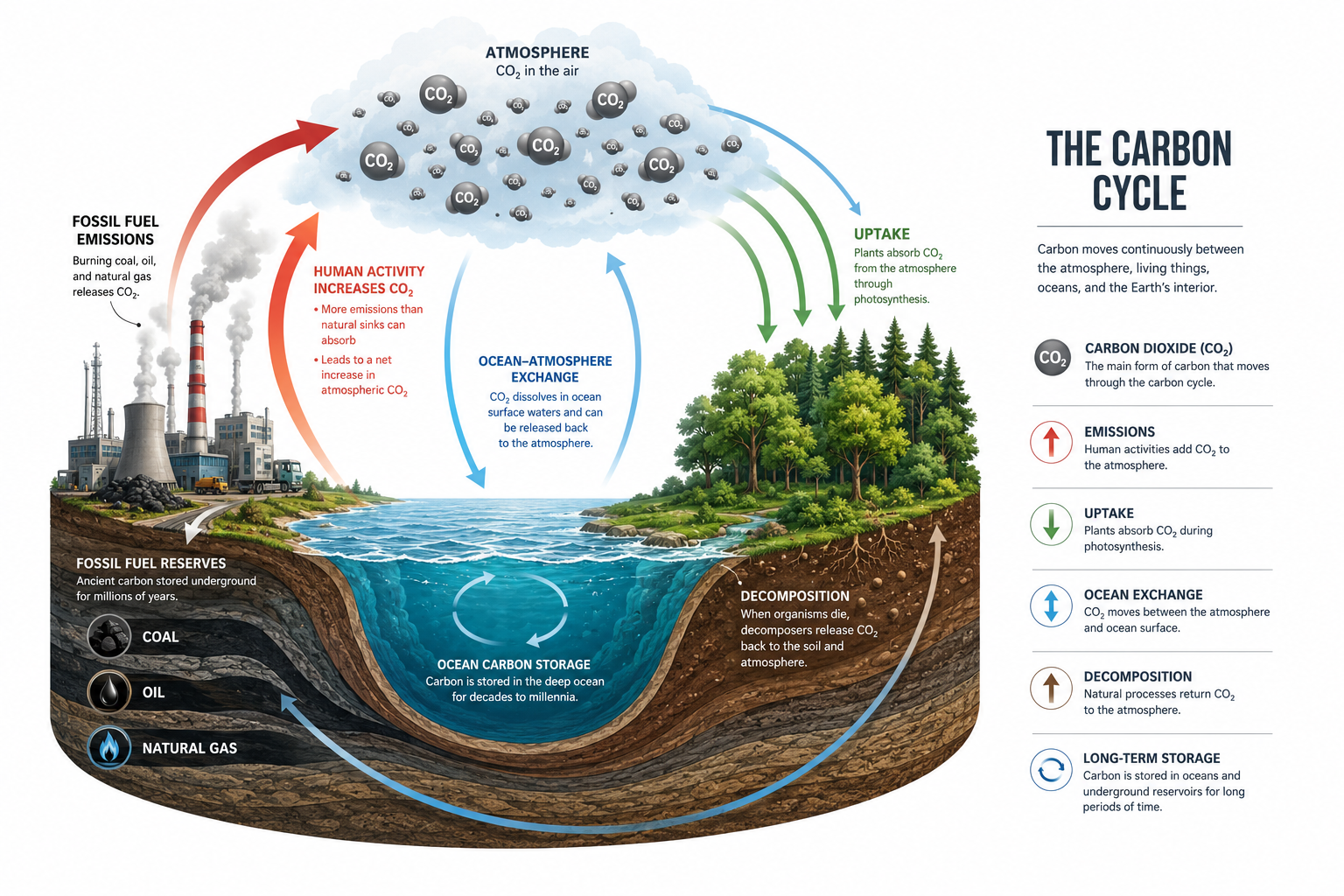
🌿 The carbon cycle
The constant movement of carbon between the atmosphere, oceans, land and living things. Human activity has pushed more carbon into the atmosphere than natural processes can currently absorb.
Is this actually happening?
Yes. The evidence sets out what's been measured: greenhouse gas levels, global temperature records, sea level data and more, drawn from Met Office and international climate science sources.
💡 Worth knowing: some of this evidence is very clear-cut, like global temperature rise. Some parts are less certain, and this resource says so where that's the case rather than overstating it.
Ready for the data? See the evidence — what's actually been measured, and by whom.